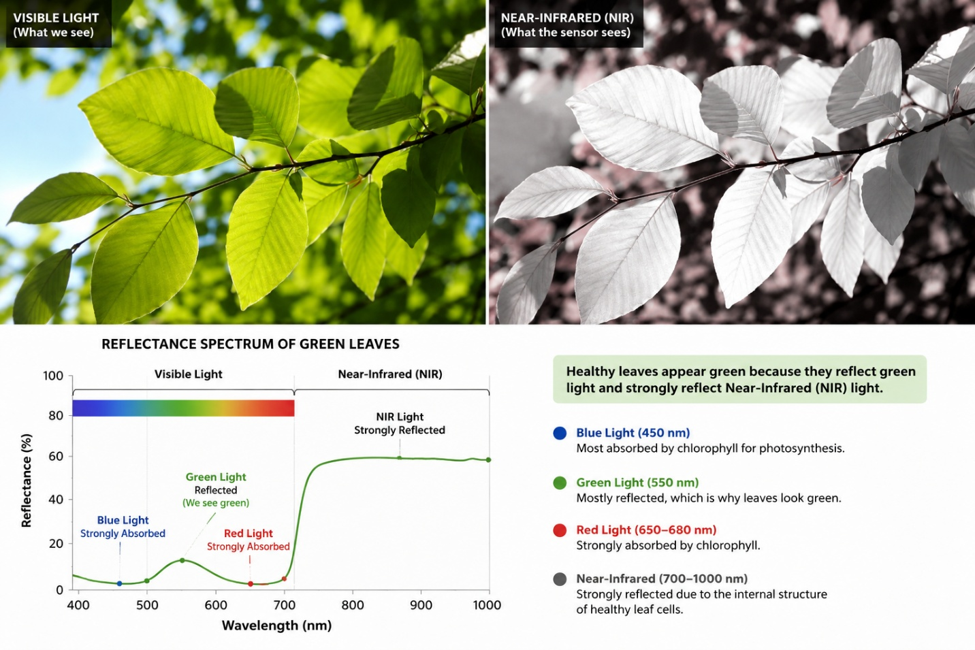
Rajah: NIR sensor pada tumbuhan
Pernahkah kita tertanya-tanya mengapa kebanyakan daun berwarna hijau? Warna hijau sebenarnya datang daripada pigmen klorofil yang terdapat di dalam daun. Klorofil berfungsi menyerap cahaya matahari, terutamanya cahaya berwarna merah dan biru, untuk menjalankan proses fotosintesis. Namun, cahaya hijau tidak banyak diserap, sebaliknya dipantulkan semula. Cahaya hijau yang dipantulkan inilah yang sampai ke mata kita, menyebabkan daun kelihatan hijau. Walaupun begitu, daun sebenarnya berinteraksi dengan pelbagai jenis cahaya yang tidak dapat dilihat oleh mata manusia.
Dalam bidang remote sensing atau penderiaan jauh, saintis menggunakan satelit, dron dan sensor khas untuk mengesan pantulan cahaya daripada daun. Dengan maklumat ini, petani boleh bertindak lebih awal, menjimatkan kos, mengurangkan kerugian dan meningkatkan hasil tuaian. Inilah bukti bahawa teknologi kini menjadi 'mata tambahan' kepada sektor pertanian moden. Sensor ini bukan sahaja merekod cahaya yang boleh dilihat, malah turut mengesan cahaya inframerah dekat (Near Infrared, NIR). Daun yang sihat akan memantulkan cahaya NIR dengan sangat tinggi kerana struktur sel di dalam daun masih baik. Sebaliknya, daun yang mengalami tekanan akibat kekurangan air, penyakit atau kekurangan nutrien akan memantulkan cahaya NIR pada kadar yang lebih rendah. Perbezaan pantulan ini membolehkan keadaan tumbuhan dikenal pasti tanpa perlu melihatnya secara dekat.
Oleh sebab itu, teknologi remote sensing digunakan secara meluas dalam pertanian, perhutanan dan pemantauan alam sekitar. Melalui analisis pantulan cahaya, keadaan tanaman dapat dipantau dengan cepat dan meliputi kawasan yang sangat luas. Sebagai contoh, petani boleh mengesan kawasan tanaman yang mula mengalami tekanan sebelum perubahan warna daun dapat dilihat dengan mata kasar. Ini membolehkan tindakan awal diambil untuk mengurangkan kerugian dan meningkatkan hasil tanaman. Ringkasnya, warna hijau daun bukan sekadar cantik dipandang, malah menjadi petunjuk penting yang membantu teknologi remote sensing menilai kesihatan tumbuhan dari udara dan angkasa.
Rujukan:
Huang, S., Tang, L., Hupy, J. P., Wang, Y., & Shao, G. (2020). A commentary review on the use of normalized difference vegetation index (NDVI) in the era of popular remote sensing. Journal of Forestry Research, 32(1), 1–6. https://doi.org/10.1007/s11676-020-01155-1
Li, X., Zhang, Y., Wang, H., & Chen, J. (2025). A comprehensive review of crop chlorophyll mapping using remote sensing technologies. Remote Sensing, 17(8), 1456. https://doi.org/10.3390/rs17081456
Haque, M. A., Kim, J., & Lee, D. (2024). Effects of environmental conditions on vegetation indices derived from multispectral remote sensing: A review. Korean Journal of Remote Sensing, 40(5), 1073–1098.
Tarikh Input: 10/08/2026 | Kemaskini: 10/08/2026 | hasniah
PERKONGSIAN MEDIA