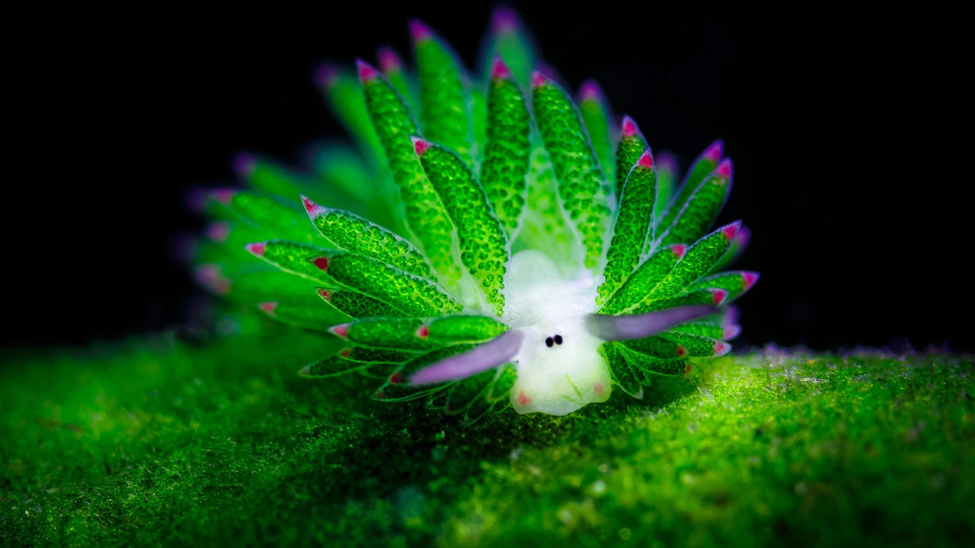
In the world of science, photosynthesis is usually associated with plants, algae, and certain bacteria. We often imagine animals as organisms that need to search for and consume food in order to survive. However, the reality of nature is stranger and more fascinating than we might think. In the tropical waters of Asia, there exists a small slug that looks like a cute baby goat with a leaf-shaped body, and it is also able to use sunlight to produce energy. This extraordinary slug is known as Costasiella kuroshimae, or more popularly called the "leaf sheep slug".
What makes the leaf sheep slug so unique is its ability to store chloroplasts from the algae it consumes. This process is called kleptoplasty, which is the ability to steal and store chloroplasts from algal cells for use in its own body. After consuming green algae, the slug absorbs the chloroplasts into its tissues. These chloroplasts remain active and allow the slug to perform photosynthesis, just like plants. This is the secret behind why the slug’s body is bright green, with leaf-like structures neatly arranged like the fur of a sheep.
This photosynthetic ability helps the leaf sheep slug survive longer even with minimal food sources, especially when food is scarce. Although photosynthesis is not the slug’s only source of energy, it gives it an extraordinary survival advantage. This phenomenon makes it one of the best examples of a unique relationship between an animal and photosynthetic organelles from algae, proving that the boundary between “animal” and “plant” in biology is not always clear.
Unlike Elysia chlorotica, another photosynthetic sea slug species that has been widely studied, the genetic mechanisms of the leaf sheep slug are still not fully understood. So far, there is no strong evidence showing that gene transfer occurs between the algae and this slug. However, the chloroplasts’ ability to remain active inside the slug's body continues to attract the attention of scientists. It opens new research opportunities on extreme adaptation, symbiosis, and the potential biotechnological applications of photosynthesis in animals.
Besides attracting researchers, this slug also captivates people worldwide. Its appearance, which resembles a tiny baby sheep with small eyes, ear-like antennae, and a leafy green body, has made it a social media sensation. Many describe it as one of the “cutest animals in the ocean,” yet behind its adorable look lies an impressive biological ability rarely seen in the animal world.
The story of Costasiella kuroshimae not only showcases evolutionary creativity but also serves as an excellent educational resource for introducing students to concepts such as photosynthesis, symbiosis, evolution, and marine biology. It teaches us that life is constantly evolving in unexpected ways, adapting to its environment, and sometimes producing strategies that appear to combine the worlds of plants and animals.
Ultimately, this leaf sheep slug reminds us that nature still holds many mysteries. Within its tiny body lies a story of biological innovation that inspires future science. Discoveries like this open our minds to the wonders of biodiversity and encourage us to continue exploring the secrets of ocean life, because sometimes, the greatest wonders come from the smallest and cutest creatures.
References:
- Christa, G., Gould, S. B., Franken, J., Vleugels, M., Karmeinski, D., Händeler, K.,... & Wägele, H. (2014). Functional kleptoplasty in a limapontioidean genus: phylogeny, food preferences and photosynthesis in Costasiella, with a focus on ocellifera (Gastropoda: Sacoglossa). Journal of Molluscan Studies, 80(5), 499-507.
- Cruz, S., & Cartaxana, P. (2022). Kleptoplasty: Getting away with stolen chloroplasts. PLoS biology, 20(11), e3001857. https://doi.org/10.1371/journal.pbio.3001857
- World Wildlife Fund. (2025, Fall). Meet the Costasiella sea slug, an animal that can photosynthesize. World Wildlife Magazine. https://www.worldwildlife.org/news/magazine/fall-2025/meet-the-costasiella-sea-slug-an-animal-that-can-photosynthesize/
By:
Dr. Siti Nor Ani Azaman
Unit Biologi, ASPutra UPM.
Date of Input: 05/11/2025 | Updated: 05/11/2025 | hasniah
MEDIA SHARING