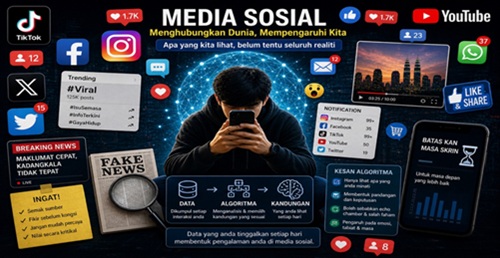
Scenario: Scrolling Through Social Media Without Realising It
Imagine this situation.
You open TikTok just for “a few minutes” before going to bed, but without realising it, an hour has passed. Video after video keeps playing, all of them interesting, all of them seemingly “made just for you.” This is not a coincidence. Behind every video appearing on your screen lies a highly sophisticated system that has learned your habits, interests, and behaviour far more deeply than you may realise.
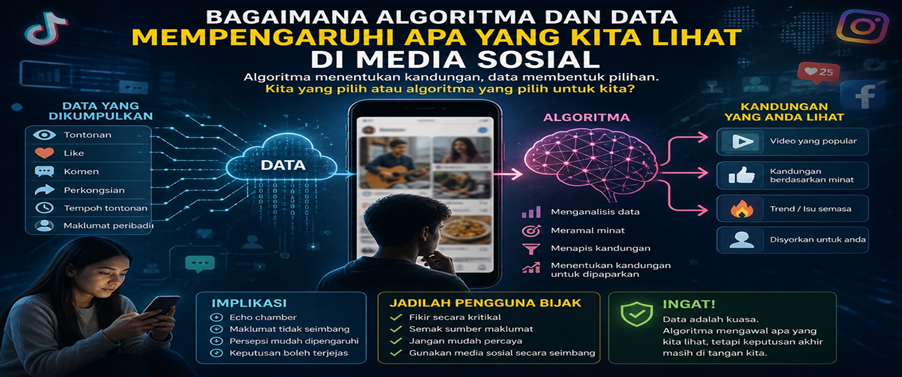
In today’s rapidly evolving digital era, social media platforms such as TikTok, Instagram, Threads, and Facebook have become an important part of daily life, especially among students and younger generations. These platforms are not only used for communication, but have also become major sources of information, entertainment, and learning. However, the content displayed to users does not appear randomly. Instead, it is determined by algorithms and data analysis.
The question is: to what extent do algorithms influence the way users think and make decisions? Are we the ones choosing the content, or is the content choosing us? The answer to this question carries far greater implications for our lives. Social media is no longer merely entertainment; it shapes the way users receive information, form opinions, and perceive reality.
Understanding Algorithms: The Mathematics Behind Your Screen
In simple terms, an algorithm is a set of mathematical instructions used by computer systems to make decisions automatically. In the context of social media, algorithms, often referred to as content recommendation mechanisms, function to select and arrange content considered most relevant to users. This process relies on data collected from user activities such as likes, comments, shares, and viewing duration.
From a mathematical and statistical perspective, algorithms operate based on concepts of probability and data analysis. Every user interaction is recorded and analysed to predict which content is most likely to attract attention. For example, content with a high engagement rate has a greater probability of being displayed to other users. In other words, the more data collected, the more accurately the system “understands” you.
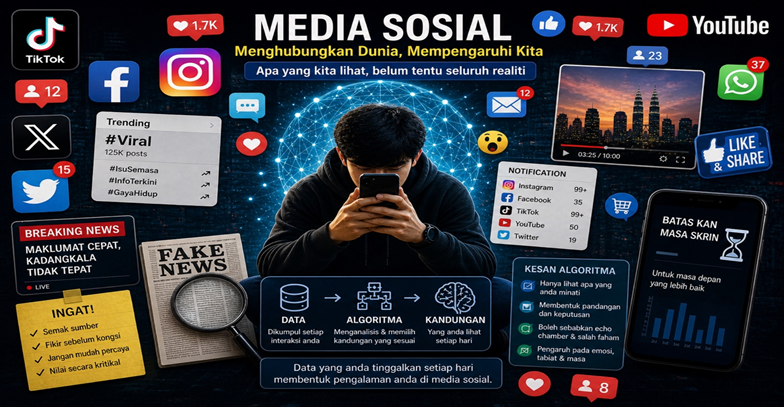
The Reality in Malaysia: Eye-Opening Statistics
In Malaysia, social media usage is at a very high level. Reports indicate that most Malaysians are active internet and social media users. In addition, there are approximately 19.3 million TikTok users in the country, reflecting the platform’s strong influence on society. Statistics also show that Malaysian TikTok users spend dozens of hours each month on the platform. This situation allows more data to be collected and analysed, continuously improving the accuracy of algorithms over time. These findings demonstrate that algorithms possess significant power in determining the information received by a large portion of the population every day.
The Hidden Danger: The Echo Chamber Trap
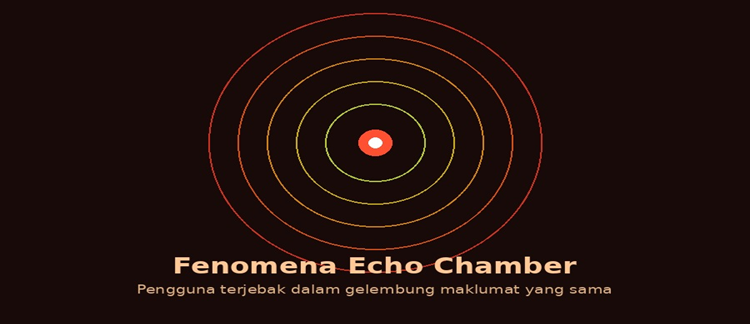
The use of algorithms can lead to the phenomenon known as an echo chamber, where users are only exposed to content that aligns with their existing interests and opinions. This limits exposure to different perspectives and may reduce critical thinking.
For example, if someone frequently watches content related to a particular issue, the algorithm will continue showing similar content without considering alternative viewpoints. As a result, users may begin to believe that such views represent the only truth. This phenomenon can affect social unity by creating divisions in perspectives among different groups. More concerningly, it may influence perceptions of important issues such as politics, economics, and health.
Economic Impact and Influence on Digital Business
Beyond its social effects, algorithms also play an important role in the economy. In Malaysia, platforms such as TikTok are reported to contribute approximately RM20 billion to the national economy while also creating thousands of job opportunities. This shows that algorithms not only influence individuals but also have a significant impact on businesses and the national economy.
The influence of algorithms has extended far beyond personal spaces and now shapes the worlds of business, marketing, and employment.
Viral Does Not Always Mean True!
Nevertheless, there are negative effects that deserve serious attention. Sensational or controversial content tends to attract more attention and is therefore more likely to go viral. This can lead to the spread of inaccurate or misleading information.
In such situations, statistics such as the number of views and likes are often perceived as proof of credibility, when they merely reflect popularity. Popularity is only a measure of attention, not a measure of truth.
Therefore, users must remain cautious and think critically when evaluating information obtained from social media, regardless of how many people have liked or shared it. We should evaluate content wisely so that we do not become individuals who are easily deceived by popularity alone.
Knowledge Is the Best Solution
To overcome these challenges, several measures should be taken collectively.
First, data literacy among users, especially students, should be strengthened. Data literacy refers to the ability to understand, interpret, and evaluate information critically. With these skills, users can distinguish between reliable and misleading information.
Second, mathematics and statistics education should receive greater emphasis because they help students understand concepts such as probability, data analysis, and relationships between variables.
Third, social media platforms themselves should be more transparent in explaining how their algorithms function. Cooperation among users, educational institutions, and authorities is essential in ensuring more responsible social media usage.
Conclusion: Be a Wise User Who Controls, Not One Who Is Controlled
In conclusion, algorithms and data play a major role in determining what we see on social media. Statistics in Malaysia show that this influence is becoming increasingly widespread and affects many aspects of life, including social and economic matters. Although this technology provides many benefits, we should not depend on it entirely without critical evaluation.
Returning to the question raised at the beginning of this article — who really controls what we watch? The answer ultimately depends on us.
In a world driven by data, the ability to think analytically is no longer optional, but essential. As wise users, we must understand how these systems work and use that knowledge to make more rational, constructive, and mature decisions so that we control the screen, rather than letting the screen control us.
Let us work together to build positive social media habits. Technology should help people make better decisions; not silently control the way people think.
Rujukan
- (2025). Digital 2025: Malaysia. https://datareportal.com/reports/digital-2025-malaysia
- Malay Mail. (2026, March 10). TikTok contributes RM20 billion to Malaysia's economy. https://www.malaymail.com
- Pariser, E. (2011). The Filter Bubble: What the Internet Is Hiding from You. Penguin Press.
- Suruhanjaya Komunikasi dan Multimedia Malaysia. (2024). Internet users survey 2024.
- The Global Statistics. (2025). Malaysia TikTok user statistics. https://www.theglobalstatistics.com/malaysia-tiktok-user-statistics/
- World Economic Forum. (2023). Future of Jobs Report. WEF Publications.
Disediakan oleh,
Wan Nur Atikah Wan Mohd Adnan
Education Services Officer (Mathematics)
Date of Input: 05/06/2026 | Updated: 05/06/2026 | hasniah
MEDIA SHARING