Just like every product in a shop has a barcode, every species on earth carries its own unique genetic code or DNA barcode. This is a short, standardized segment of DNA that acts like a molecular ID card. Scientists use these barcodes to identify species quickly and accurately even if they look very similar or are difficult to recognize with the naked eye.
Why DNA Barcodes Matter?
Biodiversity is under threat worldwide due to habitat destruction, overexploitation, pollution, climate change and the spread of many invasive species. This makes accurate identification and monitoring of species more critical than ever. Traditional methods of species identification, which rely primarily on examining physical traits such as body shape and coloration can be slow and unreliable technique. This is especially true for juvenile individuals, species that are morphologically similar or specimens that have been processed and preserved. In response to these limitations, DNA barcoding has emerged as a faster, more precise and reproducible method for identifying species.
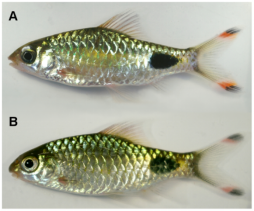
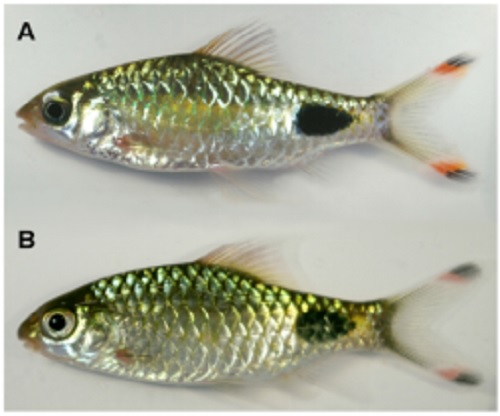
Illustrating the utility of DNA barcodes in biosecurity. Puntius filamentosus (A) and P. assimilis (B) are two species of fishes strikingly similar in appearance. The morphological differences are difficult to discern when they are exported to other countries as juveniles.
How Does a DNA Barcode Work?
In a supermarket, a barcode reader doesn't scan the whole product. It scans a small patch of black-and-white lines that uniquely represents that item.
DNA barcoding works on the exact same principle:
- Pick a standard genetic region: Instead of reading an entire genome (which consists of billions of letters), scientists target a short, specific gene sequence that exists in almost all living things.
- Read the letters: DNA is made of four chemical bases: A (adenine), T (thymine), C (cytosine), and G (guanine). The specific order of these 650 letters acts like the arrangement of black and white stripes.
- Scan and match: Scientists take the unknown sample's sequence and run it against a global reference database, such as the Barcode of Life Data System (BOLD). If the sequence matches an existing record, the mystery species is identified.
Real-World Applications
DNA barcoding is no longer confined to academic research; it has become an important tool in a wide range of practical applications.
- Catching seafood fraud:Fish fillets often look identical once skinned and frozen. DNA barcoding has repeatedly revealed "sushi fraud", where cheaper fish like tilapia or catfish are sold as expensive red snapper or white tuna.
- Verifying herbal supplements:Herbal pills are often processed into fine powders. DNA barcoding lets inspectors test whether a bottle labelled "Ginkgo Biloba" actually contains Ginkgo or just cheap fakes.
- Protecting endangered wildlife:Customs officers use portable DNA sequencers to test confiscated powders, ivory carvings or bushmeat to catch poachers smuggling protected species.
- Monitoring Ecosystems (eDNA):Scientists can test just a cup of river water for shed genetic material ("environmental DNA") to list every organism living there without catching a single one.
References
- Collins, R. A., Armstrong, K. F., Meier, R., Yi, Y., Brown, S. D. J., Cruickshank, R. H., Keeling, S., & Johnston, C. (2012). Barcoding and border biosecurity: Identifying cyprinid fishes in the aquarium trade. PLOS One, 7(1), e28381. https://doi.org/10.1371/journal.pone.0028381
- Lukhtanov, V. A., Sourakov, A., & Zakharov, E. V. (2016). DNA barcodes as a tool in biodiversity research: Testing pre-existing taxonomic hypotheses in Delphic Apollo butterflies (Lepidoptera, Papilionidae). Systematics and Biodiversity, 14(6), 599–611. https://doi.org/10.1080/14772000.2016.1203371
- https://ibol.org/about/dna-barcoding/
Prepared by
Dr. Nadiatul Hafiza Hassan
Unit Biologi
ASPutra
Date of Input: 11/08/2026 | Updated: 11/08/2026 | hasniah
MEDIA SHARING