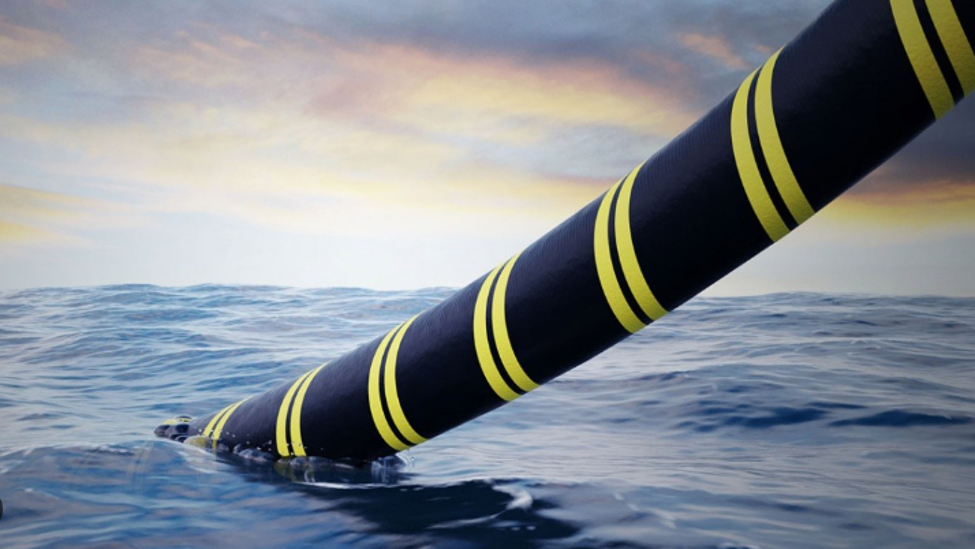
Figure: Submarine cable. Image Google image
When we send a message, watch a video, or make a bank transaction, we might imagine that the data flies through satellites. Most international data take a “humbler” path, diving to the ocean floor!
Submarine cables carry over 99 percent of international data traffic. In 2025, this global network consisted of more than 500 cable systems spanning approximately 1.4 million kilometers. In short, the world's internet swims much more than it flies.
The secret to its speed lies in extremely fine optical fibers. Data is converted into pulses of light before being transmitted across the ocean. This is where physics plays a role through the principle of total internal reflection.
An optical fiber has a core with a higher refractive index than the surrounding cladding. When light travels at an angle greater than the critical angle, it does not escape fiber. Instead, it is repeatedly reflected inside the core, as if traveling through a mirrored tunnel. Because of this, information can travel thousands of kilometers with low energy loss. Signal amplifiers or repeaters are installed at specific intervals to ensure the signal remains clear throughout the journey.
Malaysia is also located along a strategic route in this network. The Candle cable project, scheduled to be operational in 2028, will connect Malaysia with Japan, Taiwan, the Philippines, Indonesia, and Singapore. The cable, spanning approximately 8,000 kilometers, is planned to have a capacity of up to 570 terabits per second.
However, these cables are not invincible. Ship anchors, fishing activities, earthquakes, and underwater landslides can sever them. Over 170 cable repair operations were reported worldwide in 2025. That is why backup routes, monitoring, and international cooperation are becoming increasingly important.
Beneath the seemingly quiet waves, light is “running” non-stop. It reminds us that physics is not merely formulas in a textbook, but an invisible bridge that unites the entire world.
References:
- International Telecommunication Union, International Advisory Body on Submarine Cable Resilience Report, 2026.
- International Telecommunication Union, Global Connectivity Report 2025.
- Meta Engineering, Introducing the Candle Subsea Cable, 2025.
Published by :
Gs. Dr. Ya’akob Mansor, IGRSM
Senior Lecturer, Unit Physics
Centre of Foundation Studies in Science
Universiti Putra Malaysia (UPM)
43400 Serdang, Selangor Darul Ehsan
MALAYSIA
Date of Input: 10/08/2026 | Updated: 10/08/2026 | hasniah
MEDIA SHARING