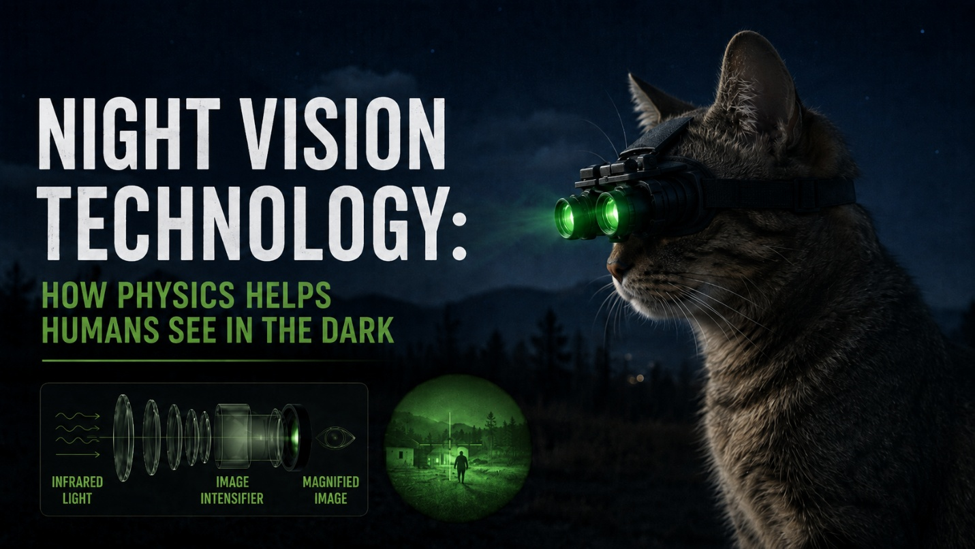
Figure: Illustration of night vision technology
“And it is He who placed for you the stars that you may be guided by them through the darknesses of the land and sea.” (Surah al-An‘am, 6:97)
For centuries, humans relied on the moon and stars to find their way in the dark. Today, they no longer depend only on the night sky. By understanding the physics of light and infrared waves, humans have developed night vision technology that allows dark environments to be seen more clearly.
There are two main types of night vision technology: image intensification and thermal imaging.
An image intensifier works like a “loudspeaker for light”. Even when an area appears dark, there is usually still a small amount of light from the moon, stars or surrounding environment. Light is made up of tiny particles known as photons.
These photons enter the goggles through a lens and are converted into electrons by a photocathode. The electrons are then multiplied through a microchannel plate before striking a phosphor screen. This process creates a brighter image that can be seen by the user. The display is usually green because the human eye can distinguish more shades of green than many other colours.
But what happens when the area is completely dark?
This is where thermal imaging becomes useful. All objects with a temperature above absolute zero release energy in the form of infrared waves. Human bodies, animals, engines and vehicles all produce heat. Thermal sensors detect these temperature differences and turn them into images. In simple terms, this technology does not see light—it “sees” heat.
Modern technology has become even more advanced by combining image intensification and thermal imaging in a single device. Current night vision goggles may also include digital displays, navigation systems, object recognition and artificial intelligence. AI can improve image quality, reduce blur and make targets easier to identify.
However, this technology still has limitations. Very bright light can cause glare, while rain, smoke and fog may reduce image clarity. Using goggles for too long can also cause eye fatigue and make it more difficult to judge distance accurately.
In conclusion, humans may not have eyes like cats. However, through the physics of light, infrared waves and artificial intelligence, the night is no longer as dark as it once was.
References:
- Chrzanowski, K. (2020). Advances in Night Vision Technology. Opto-Electronics Review.
- U.S. Army (2021). Night Vision Device Training and Operations Manual.
- NASA (2023). Infrared Radiation and Thermal Imaging. NASA Science.
- Defence Science and Technology Laboratory (DSTL) (2024). Modern Imaging Systems for Low-Light Environments.
Gs. Dr. Ya’akob Mansor, IGRSM
Senior Lecturer, Unit Physics
Centre of Foundation Studies in Science
Universiti Putra Malaysia (UPM)
43400 Serdang, Selangor Darul Ehsan
MALAYSIA
Date of Input: 10/08/2026 | Updated: 10/08/2026 | hasniah
MEDIA SHARING