Introduction
The Prisoner’s Dilemma is a well-known concept in game theory that illustrates how two individuals must choose between cooperation and self-interest. Each person can either cooperate with the other for a shared benefit or act selfishly to gain personal advantage. The dilemma arises because decisions that appear rational for each individual can ultimately produce an outcome that is worse for both parties.
In this simplified model, two individuals each have two possible choices, creating four potential outcomes. If one prisoner testifies (defect) while the other remains silent (cooperate), the testifying prisoner is released, and the silent prisoner receives a severe sentence. If both prisoners testify, they each receive a moderate prison sentence. In contrast, if both prisoners remain silent, they receive the lightest sentence for a lesser offense.
From this scenario, it can be concluded that although cooperation results in the most favorable collective outcome, each prisoner is motivated to testify in order to protect their own interests. As a result, both prisoners are likely to choose betrayal, leading to a less optimal outcome for both, which demonstrates the central paradox of the Prisoner’s Dilemma.
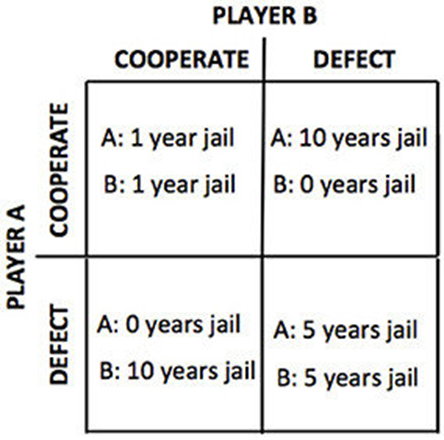
Figure 1: Payoff matrix of possible outcomes
Real life Examples of Prisoner’s Dilemma
The Prisoner’s Dilemma is not limited to theoretical or abstract situations; it frequently appears in everyday decision-making and real-world interactions. The following examples illustrate how the structure of the Prisoner’s Dilemma manifests in real-life contexts, highlighting the tension between individual incentives and optimal group outcomes.
- Studying for a group project
In a group project, two students each decide whether to work hard or slack off; if both put in effort, they earn a high grade with less stress, but if one slacks while the other works, the slacker benefits at the expense of the hardworking student, and if both slack off, they receive a poor grade, making it a Prisoner’s Dilemma because slacking is individually tempting yet leads to a worse outcome when both students choose it
2. Price Competition Between Firms
In a price competition between firms, two rival companies may choose either to maintain high prices or to undercut one another; while mutual price stability yields higher profits for both, each firm has an incentive to lower prices to gain market share, often resulting in a price war that reduces profits for both, thereby reflecting the structure of the Prisoner’s Dilemma.
3. Climate change diplomacy
Climate negotiations among countries also reflect Prisoner’s Dilemma logic: each country would benefit from a stable climate (cooperate by reducing emissions), but each one fears other countries might not cut emissions. So, despite the mutual benefit of cooperation, nations often pursue self-interest, resulting in outcomes worse than global cooperation.
Conclusion
The Prisoner’s Dilemma illustrates how rational, self-interested decision-making can lead individuals or organizations to outcomes that are collectively inefficient. Across real-life contexts, the temptation to defect for personal gain often undermines cooperation, resulting in worse outcomes for all parties involved. This highlights the importance of trust and coordination in encouraging cooperative behavior and improving collective outcomes.
References
- Dao, Y. (2024). The Prisoner’s Dilemma: Real Life Application of Game Theory. Faculty of National Security, Republic of Indonesia Defense University.
- Alessio Carrozzo Magli, P., and Manfredi, P. (2022). Coordination games vs Prisoner’s Dilemma in sustainability games: A critique of recent contributions and a discussion of policy implications. Ecological Economics, 192, 107268.
- Johnson, D. D. P., Stopka, P., and Bell, J. (2002). Individual variation evades the Prisoner's Dilemma. BMC Evolutionary Biology. 2:15.
- Moreira, C. and Wichert, A. (2016). Quantum Probabilistic Models Revisited: The Case of Disjunction Effects in Cognition. Frontiers in Physics. 4:26.
- Peterson, M. (Ed.). (2015). The Prisoner’s Dilemma. Cambridge University Press.
Author
Pn. Nur Syazana Rashid
Mathematics Unit,
Pusat Asasi Sains Universiti Putra Malaysia (ASPutra).
Date of Input: 24/02/2026 | Updated: 25/02/2026 | emma
MEDIA SHARING