In everyday life, we often find ourselves buying more items than we truly need, frequently assigning this behavior to social pressure. However, many of these buying decisions stem from internal psychological influences rather than external demands, known as Diderot Effect.
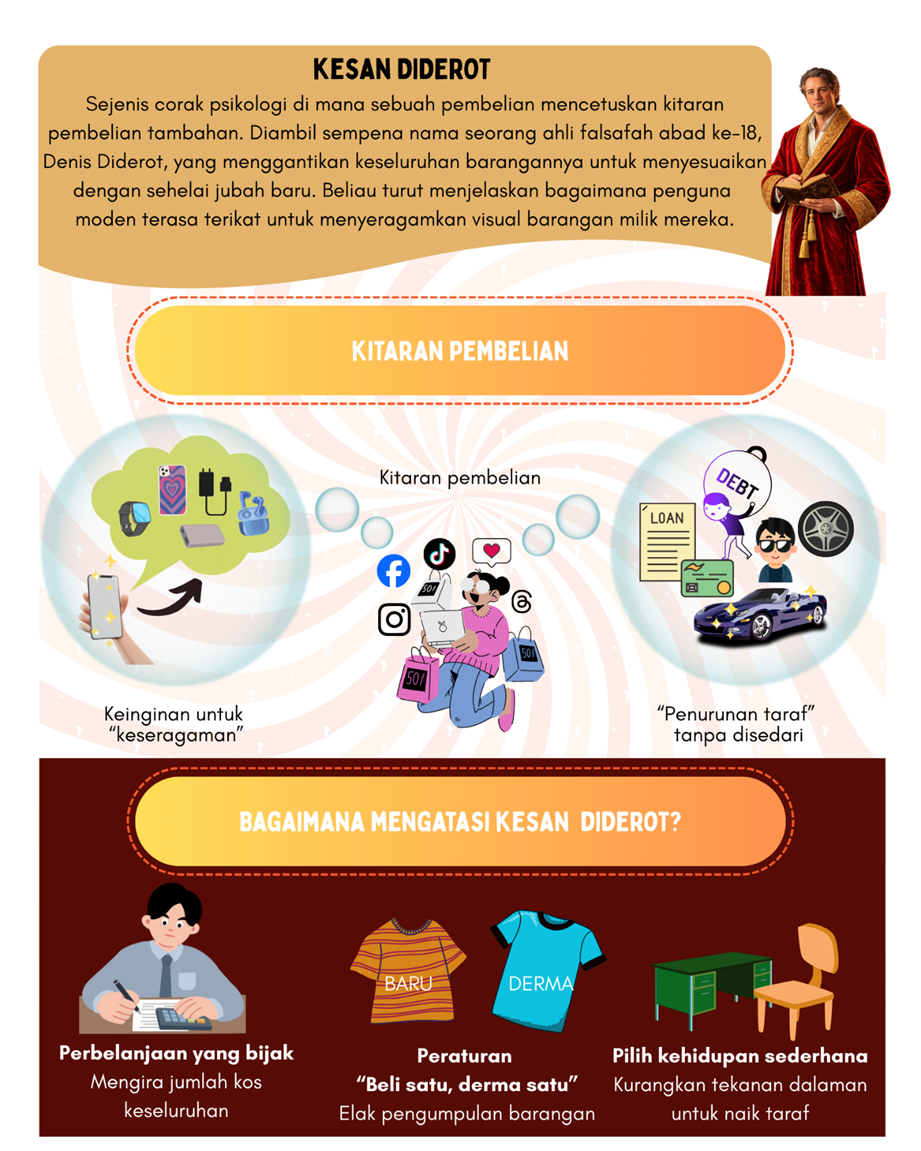
The Diderot Effect refers to a psychological phenomenon in which gaining a new possession triggers a chain reaction of additional consumption (Santos et al., 2025). The concept originates from the 18th-century French philosopher, Denis Diderot. In his essay “Regrets on Parting with My Old Dressing Gown”, Diderot described receiving a new luxurious robe that made his existing possessions unsuitable. As a result, he felt obligated to replace them with more elegant items leading to financial strains.
Today, the Diderot Effect is even more prevalent due to modern marketing strategies that mainly driven by social media. The introduction of a new item often encouraging continuous upgrading. Ironically, these “upgrades” can become a form of disguised downgrade as new possessions may create stress, financial pressure and reducing personal freedom. This effect can be seen in daily life. For instance, purchasing a new smartphone often leads to buying a matching phone case, charger and earphone. Similarly, buying a new car may result in spending more money on accessories (Stemper, 2026).
To overcome the Diderot Effect, several strategies can be applied. First, practice mindful spending to prevent the potential chain reaction by considering the total cost of all related purchases. Second, adopt a “buy one, give one” rule to prevent items accumulations. Lastly, choosing frugal lifestyle options to reduce pressure to constantly upgrade and promote greater financial freedom (White, 2025). By becoming aware of the Diderot Effect in everyday life, individuals can make more mindful purchasing decisions and avoid becoming its victim.
References:
Santos, A., António, N., & Rita, P. (2025). The Diderot effect: a data-driven validation. Journal of Marketing Analytics. https://doi.org/https://doi.org/10.1057/s41270-024-00371-6
Stemper, D. (2026). The Diderot Effect: The consumer trap and its impact explained simply. Dr. Stemper. The Diderot Effect: The consumer trap and its impact explained simply
White, R. G. (2025, April 17). The Cautionary Tale of Diderot (and How He Spent His Dough): The Diderot Effect captures how one purchase can trigger a spending spree. Psychology Today.
Author: Dr. Ezyana Kamal Bahrin
Biology Unit, ASPutra
Date of Input: 08/02/2026 | Updated: 08/02/2026 | emma
MEDIA SHARING