Adding two numbers together does not always give you a higher value. You can get a higher value, a lower value, zero, and even a negative value. Why is that? That is a vector.
To understand vectors, let's look at scalars first. For example, if we add 3 kg of tomatoes and 2 kg of carrots onto a scale, we will get a total weight of 5 kg. This is a scalar. The answer is always predictable, higher, and positive. But what about a vector? Let me ask you for directions: can you give me an answer using only a scalar? For example, if I ask, "Where is the library?" you cannot simply answer, "The library is 500 meters away." That isn't enough information, and this is exactly why vectors are so important.
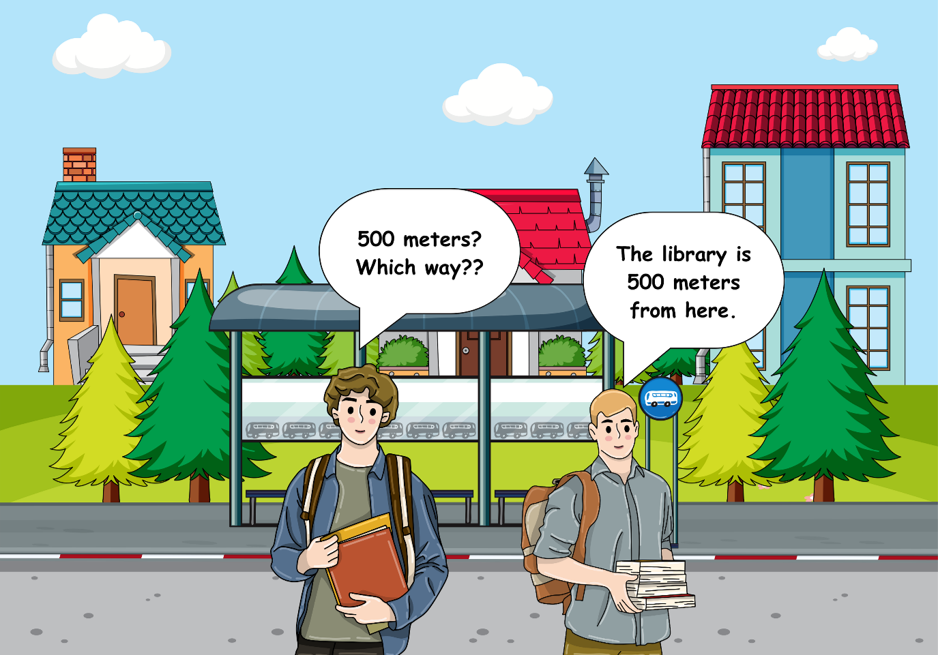
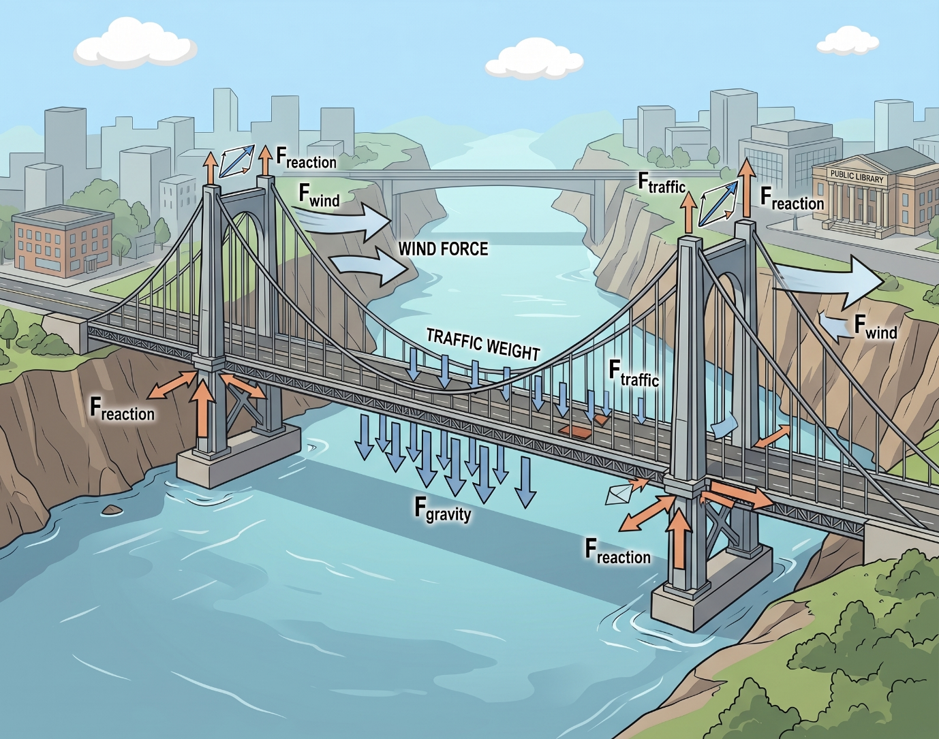
Let’s define a vector first. A vector is a quantity that has both magnitude (size) and direction. Unlike a vector, a scalar only has magnitude. So, when someone asks for directions, using a scalar doesn't help because no direction is given. Since they have both magnitude and direction, vectors help us solve a lot of problems beyond just finding a location. For example, pilots must calculate the vectors of crosswinds and gravitational pulls to stay on course. Similarly, when designing a bridge, engineers need to calculate the vector forces of gravity, wind, and traffic weight to ensure the building structure can push back with the same amount of force.
You have probably heard about vector art before, right? Vectors help us resize an image so that it does not become blurry or pixelated. Vector art is based on lines and directions rather than a grid of colored dots. Because of this, any images can be resized to the size of a billboard or a business card without losing its quality.
Now, where is the library again? Before we can answer that, let’s talk about the arrow analogy. An arrow can be used to represent a vector. The length of the arrow represents the magnitude, and the point of the arrow represents the direction. In short, vectors allow us to map, quantify, and predict movement and relationships in a multidimensional world. They connect abstract numbers to physical reality. While scalars tell you how much, vectors tell you where to go. Vectors definitely give you the ultimate roadmap for everything. 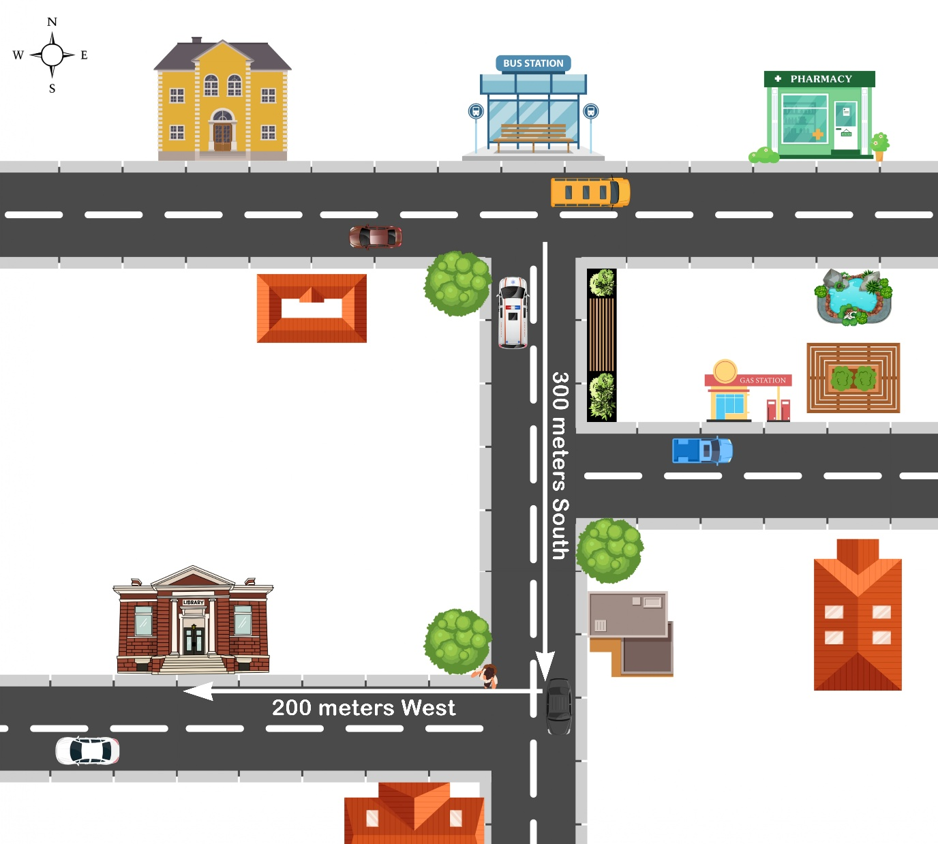
Finally, to answer our earlier question: if you want to go to the library, you can walk 300 meters South and then 200 meters West. By giving both the magnitude and the direction, we can finally find the library and continue our reading about vectors!
Prepared by :
Noor Wahidah Zainol Jamil,
Education Service Officer
Physics Unit, ASPutra
Date of Input: 06/07/2026 | Updated: 30/07/2026 | emma
MEDIA SHARING